Writing back to power
Explore the hidden histories of the Church of England, colonialism and transatlantic slavery through archival material, film, poetry and creative work by young people.
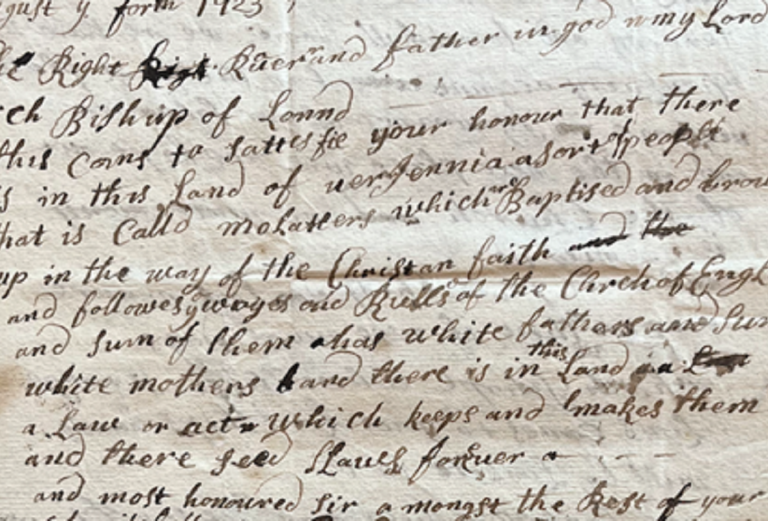
Fulham Palace has worked with Parent Action Resource Centre (PARC) to review archival material held in the ‘Fulham Papers’ at Lambeth Palace Library, to reflect on what that material says about the role of the Church of England and the Bishop of London, culminating in a temporary exhibition in autumn 2026. A group of young people from PARC worked with PhD student Eleanor Hex, storyteller Grace Quansah and filmmaker Jair Tavares to explore the involvement of the Church of England in colonialism and transatlantic slavery, but also to give voice to the enslaved people through a mix of interpretation and imagination by the group.
This exhibition has been co-curated with the young people of PARC. The exhibition will include a project film, the young people’s work and poetry, alongside images and analysis of the archival sources they interrogated.
This project was funded by Museum Development London Diversity Matters Grant.
Historical context
History allows us to properly understand the world around us. To look arounds and consider why things are the way they are. Fulham Palace is a building with history. Not just that which we can see through the architecture and the beautiful grounds: but that which is hidden to the naked eye. This palace quietly tucked away in West London is part of a story which ricochets across the world. That encompasses the lives not just of bishops and their families; but of parishioners of all kinds not just here in London but in the ‘colonies’ too.
Bishops are clergy who each oversee a part of the church known as a ‘diocese’. These are made up of a collection of smaller areas known as ‘parishes’, each of which is presided over by their own ordained vicar. These vicars look after their own individual congregations, and report back on this to their bishop. In the eighteenth-century there were 24 bishops in England, 22 of whom had a seat in the House of Lords and had political sway as well as power over the direction of the church. This made them extremely powerful men, and many of them had interests outside of the church that effected the lay in which they led.
In the early modern period, imperialism began to expand at an extremely quick pace. As trade routes started to spread across the globe, so did the Anglican communion with ministers being sent to every place where there were English merchants in order to provide them with spiritual guidance. London was the ‘metropole’, the mother city of the growing empire and so the Bishop of London took on a central role on the Board of Trade and were involved in making important decisions about commerce and industry. In 1675 Bishop Henry Compton became the Bishop of London and under approval of King Charles II took on the title of ‘Bishop of the Colonies’. This gave them power not only just over the London diocese, but over the rest of the world where the Anglican church had a base. This meant that they oversaw not only the clergy and parishes within London, but also those in far-flung places like ‘The Americas’.
Clergy members were sent by the Anglican Church to places from Nova Scotia and Newfoundland in Canada, out to places such as Barbados and Jamaica in the West Indies. Communication from these colonies was sent to the bishop- often directly to Fulham Palace- and a collection of these papers was compiled. These papers are now known as ‘The Fulham Papers’ and are kept at Lambeth Palace Library which is the national archive for the Church of England. In these volumes are thousands of documents which allow historians to better understand how the church work in the colonies from the firsthand account of those who lived there. None of the bishops of London ever visited the colonies and so they relied on letters, reports, maps and other information from their clergy, their commissaries and colonial governors to gain a picture of these places.