Written by Alexis Haslam, community archaeologist
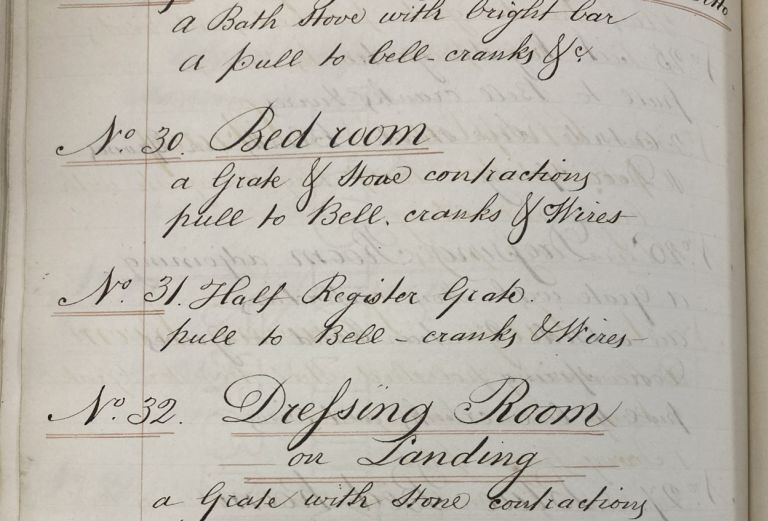
In August Fulham Palace Trust was gifted a rather interesting piece of history. A book was delivered to Roxanne, our collections and conservation officer, by the daughter-in-law of Bishop Stopford. Bishop Stopford was the last Bishop to reside at the Palace between the years of 1961 and 1973 and he passed away in 1976. The book was recovered from his library following his passing and has remained with the Stopford family ever since.
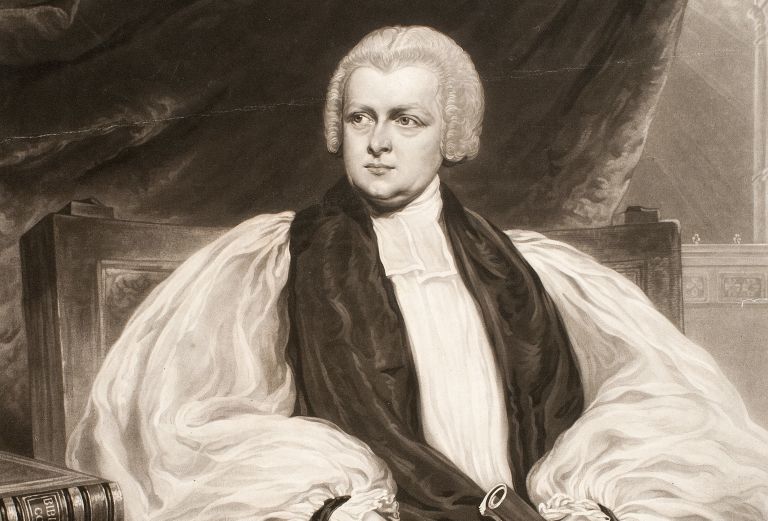
The book in question is the Inventory of the Palace furniture and fixtures etc and is dated to August 1828. This was the point at which Bishop Howley (1813 – 28) was leaving the Palace having been promoted to Archbishop of Canterbury and was being replaced by Bishop Blomfield (1828 – 1857). The inventory is a concise record of the Palace, describing its contents room by room and area by area and provides great detail on both how it was laid out and what it comprised some 200 years ago. A comparable document in the form of the Tait inventory dated to 1869 now resides in the Lambeth Palace Library and was most useful during the recent publication of the Fulham Palace monograph.
The survival of this book of course raises many questions. Before its arrival we were only aware of the Tait Inventory. Were these records routinely produced when a Bishop left the Palace? When was the first one composed? Where are the rest of them? If inventories were produced by Bishops Howley and Tait then surely another one must have been produced by Blomfield at the very least. Where is it now? Perhaps more to the point, how did Bishop Stopford acquire this book? The vast majority of the Fulham Palace library was removed to Lambeth Palace during the 1950’s.
It appears that Bishop Stopford himself received the book in November of 1967. It was presented to him by an individual named Mr L. Stainsby of Peterborough. Mr Stainsby was a solicitor and he was acting as executor of the will of Mrs Ellen Howe. He states in a letter that whilst the family had no use for the book and were happy to pass it on, they had no idea how she came to be in possession of it. So, when, how and why Mrs Howe received the Fulham Palace Inventory remains somewhat of a mystery. There are some links to Peterborough of course, with Bishop Creighton (1897-1901) in position as Bishop of Peterborough between 1891 and 1896 before his promotion to London.
So far, I have only had a quick glance at the book but there are some wonderful insights into life at the Palace during the late Georgian period. From the descriptions of the house it is clear that the male servants resided in the apartments over the arch into the Tudor courtyard. Interestingly it was the courtyard which needed significant maintenance during the tenure of Bishop Blomfield. Perhaps an area low on Bishop Howley’s priority list!
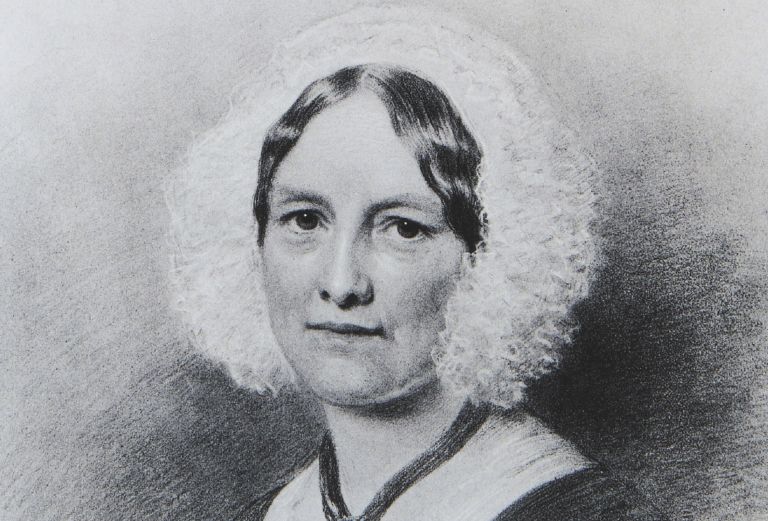
There are a substantial number of bedrooms recorded throughout the building, with one being named the blue room and one the white room. Only one occupant is specifically mentioned by name and this concerned the bedroom of a Mrs Filor. Mrs Filor it transpires was the wife of James Filor who was house steward to Bishop Howley. The Filors moved to Lambeth with Howley upon his promotion and James passed away on 26 December 1839.
Obviously of interest (to me at least) is the record of considerable amounts of beer! I have always been somewhat confused by the persistent rumours that there is a tunnel beneath the Palace that leads to the Golden Lion, supposedly constructed so that Bishop Bonner (1539 – 49 / 1553 – 59) could have a pint whilst incognito. I’m not quite sure where the concept of a teetotal clergy came from – possibly the rise of the Temperance movement in the late 19th and early 20th centuries. But the Bishops certainly enjoyed a tipple back in the day and Fulham Palace had a brewery which is understood to have produced some rather excellent ale. Howley’s inventory records that he left Bishop Blomfield 6 butts of strong beer (one butt totalling 108 gallons) and 1 butt of second brewing beer (slightly weaker beer) along with numerous further phases of the brewing process. So, Blomfield certainly inherited a well-stocked tap room!
Of further significance is the record of the gardens which provides us with information on their horticultural layout, appearance and contents. This does go into some detail, but an initial scan reveals that within the walled garden there were 6 bee skeps, 570 pots of strawberries, 122 pots of Provence moss and 10 pots of young cork trees. The gardens description also indicates that the glasshouses and bothies were extant by this time and were therefore constructed during Howley’s tenure. In the west glasshouse (where the tomatoes now grow) were 26 fig trees in pots, so figs must have been popular in the Howley household.
Whilst there is still a lot to digest in regards of the inventory’s contents, the farm is recorded as housing 14 pigs, 2 cows and 20 pigeons. It will be very interesting to compare the Howley and Tait records and to understand how the fixtures and fittings changed over the forty years between them, but the Palace is certainly grateful to have received the book which mysteriously left the Porteus library many moon ago.