By garden apprentice Ellis Lewis
Dirt, soil, mulch, earth, mud and organic matter are words we often use interchangeably, yet they describe something far more complex than first appears. Soil is not simply a growing medium, it is a living ecosystem that underpins all plant life.
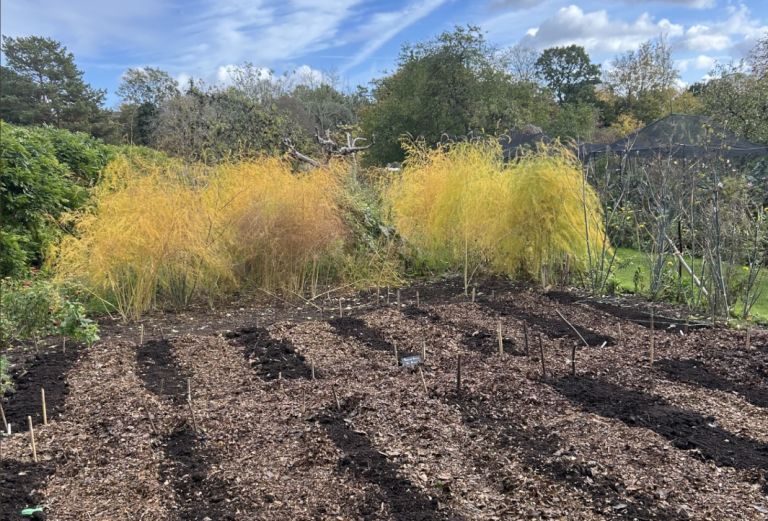
At Fulham Palace, once the vegetative season comes to an end, one of the most important periods in the gardener’s calendar begins: the winter reset. With the help of our dedicated garden volunteers, we clear annual weeds and plants that have succumbed to frost. This process prepares the garden for the next growing season while also giving us the opportunity to replenish nutrients and organic matter that have been removed during months of crop production.
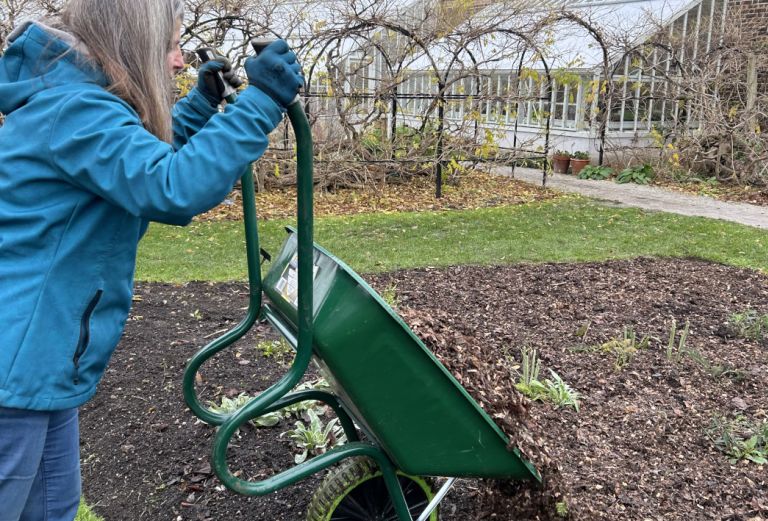
One of the key ways in which we do this is through mulching. Mulch is a layer of organic material applied to the soil surface, and here at Fulham Palace we produce all our own mulch on site as part of our sustainable garden management approach. Throughout the year, weeds, plant debris and other organic material generated through routine maintenance are collected and added to our compost bays. We operate a four-bay system, with three bays typically in use at any one time. Year one contains fresh green material in the early stages of decomposition, year two is partially rotted and continues to break down, while year three compost is fully decomposed and ready to be applied across the gardens.

When mulching, the compost is spread evenly across the soil surface in a layer approximately 5–8 cm thick, ensuring it does not sit directly against plant stems. This mimics natural processes found in woodland environments, where leaf litter gradually decomposes on the soil surface, feeding the soil from the top down rather than through disturbance.
Soil structure is critically important for plant health. An ideal soil is made up of approximately 45% mineral particles (sand, silt or clay), 25% water, 25% air and 5% organic matter. While there are many soil types, including sandy, clay and silt soils, the gardener’s ideal is loam – a balanced mix of all three mineral particles. This structure allows water and air to be readily available to plant roots at field capacity, which is the amount of water soil can hold after excess has drained away due to gravity.
Organic matter is often described as the gardener’s gold, with my college tutor never ceasing to rave about it – and for good reason. As organic matter breaks down, it binds mineral particles together into stable aggregates, improving soil structure and preventing compaction. It also increases the soil’s ability to retain moisture and nutrients, making each of these more accessible to plant roots.

Beyond physical structure, mulching plays a vital role in supporting the soil ecosystem. Compost provides a food source for bacteria, fungi, earthworms and all other macro and microorganisms that form the soil food web. It Is believed that a single tablespoon of healthy soil can contain billions of living organisms. These organisms break down organic material, release nutrients in plant-available forms and create channels within the soil that improve drainage and aeration. Fungal networks, particularly mycorrhizal fungi, help plants access nutrients and water beyond the reach of their roots, increasing resilience to stress.
Through practices such as mulching, we are not only feeding plants but supporting an entire underground ecosystem. By working with natural processes rather than against them, we create healthier, more resilient soils that will continue to support productive and sustainable gardens for years to come.