
By head gardener Lucy Hart
The grand and iconic Wisteria sinensis in Fulham Palace’s walled garden dates back at least as far as the 19th century, as it appears well-established in an image from 1901. At that time, it was supported by a series of metal hoops, some remnants of which can still be seen today. Interestingly, the sweeping arc it now grows along is already shown on an estate map from 1831, suggesting it may have been planted around then. If so, this remarkable plant could be approaching 200 years old.

Most very old Wisteria sinensis specimens are believed to have been propagated from a single original specimen. This plant once grew in Guangzhou (formerly Canton), in the garden of a Chinese merchant known to Europeans as ‘Consequa’. It had been given to him by his nephew, who brought it from Zhangzhou (formerly Changchow) in Fujian province. As very few new introductions of Wisteria sinensis have been made since the species first arrived in Europe, many plants growing here today are likely clones of that original vine.
The species was first described in 1819 by John Sims, based on a plant brought to the UK in 1816 and grown at Rooksnest, Surrey. This specimen is still thought to be among the oldest in the country, although Fuller’s Brewery in Chiswick also claims to have one of a similar age.
At Fulham Palace, two Wisteria sinensis plantings create a beautiful succession of spring flowers. The specimen growing against the Palace blooms first, warmed by the wall, while the walled garden plant follows slightly later – sometimes avoiding late frosts, though not always, as in 2012 and 2022.
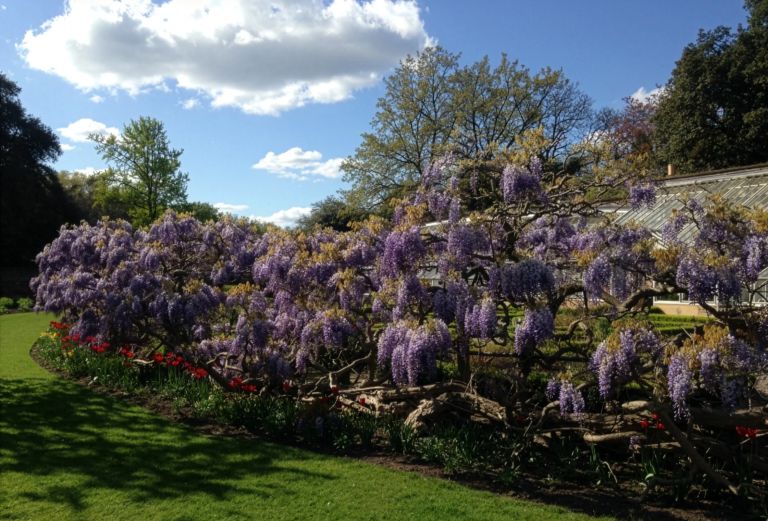
In 2020, the Trust raised £20,000 through crowdfunding to install a new bespoke steel framework for the walled garden wisteria, echoing the original hoop design and supporting this remarkable historic plant.
Today, the wisteria at Fulham Palace is carefully maintained by the garden team and a group of dedicated volunteers. Each January, it is pruned to encourage flowering spur growth, then trained along its framework, with excess whippy stems removed – many of which are reused to make wreath bases.
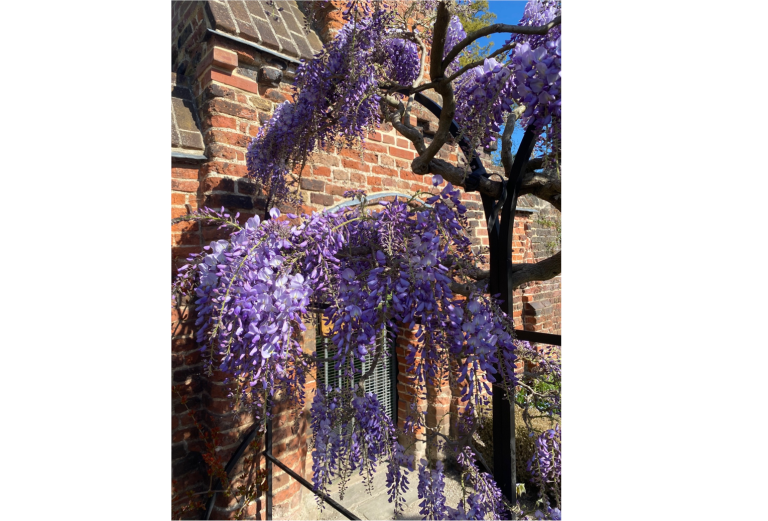
This year, we’re celebrating this much-loved plant with a special after-hours event on 17 April at Fulham Palace, inviting visitors to enjoy the wisteria in full bloom. Explore the walled garden after the gates have closed to the general public, enjoy a complimentary glass of prosecco whilst Lucy guides you through the garden and stop for a few snaps of our gorgeous wisteria in this golden hour experience. Tickets are available now at the link below.