
Written by volunteer photographer Vida Saunders.
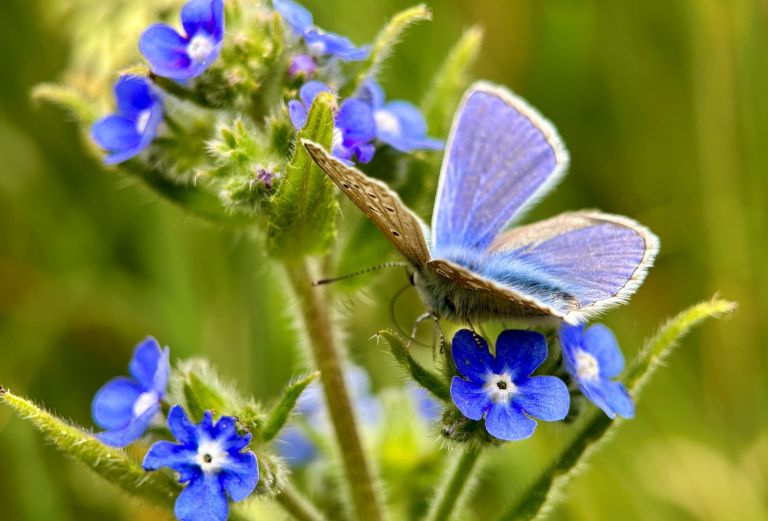
While out in the grounds of Fulham Palace at the end of July, camera in hand, I crossed paths with a tatty old male common blue butterfly (Polyommatus icarus). He was clearly a survivor from the summer’s first generation, his wings bearing the honourable tatters of a life spent dodging garden predators and weathering the elements.
But as I zoomed in for a photo, something struck me: his wings were a drastically deeper, darker blue than the bright, sky-blue youngsters I usually spot fresh out of their chrysalises around the walled garden.
Intrigued by this stark colour contrast, I began researching how these insects get their colour. What I uncovered is an absolute marvel of natural engineering. As it turns out, the butterflies dancing around our flowerbeds are playing a magnificent optical trick on us. They aren’t actually blue at all.
Phase 1: The magic behind the blue
To understand why my old Palace survivor looked so dark, we have to look at how a pristine young male common blue creates his colour in the first place.
If you were to place a butterfly wing under a high-powered microscope, you would discover it is carpeted in thousands of tiny, overlapping structures called scales. If you tried to extract a blue chemical pigment from these scales, you would fail entirely—there is none. Instead, the surface of each scale is sculpted into microscopic, three-dimensional ridges and air gaps that resemble tiny Christmas trees.
When white sunlight hits these microscopic structures, the gaps perfectly match the precise physical wavelength of blue light. The structures reflect and dramatically amplify the blue light back to our eyes while forcing other colours, like reds and yellows, to cancel each other out. This phenomenon is known as constructive interference.

But reflection is only half the battle. Beneath this microscopic architecture lies a secret base coat made of dark melanin pigment—the very same pigment that darkens human skin. This dark backing acts like a light sponge, absorbing the longer wavelengths of light that slip through the top structures. By soaking up this extra light, the melanin prevents it from bouncing back and muddying the view. This perfect contrast makes the structural blue pop with that trademark, metallic brilliance.

Phase 2: Why do the old survivors turn dark blue?
This brings us back to the tatty old male I found at the end of July.
As a butterfly flies through our undergrowth, battles the wind, escapes birds, and ages, it naturally sheds its delicate wing scales. When an old male loses the top layers of his microscopic wing structures, the blue-reflecting ‘mirrors’ disappear.
With those structures gone, the dark melanin base coat underneath is exposed to the world. It was this exposed black backing that gave my old friend his beautifully rich, weathered, deep indigo appearance. He wasn’t changing his pigments; he was simply wearing down his mirrors.

Phase 3: The secret life of females and closed wings
The story of the common blue gets even more fascinating when you look closely at the females and the undersides of their wings, both of which can be spotted if you sit quietly by the palace borders. While the males fly around shouting for attention in brilliant blues, the females play a completely different game.
Female common blues are predominantly brown, edged with beautiful orange spots. Because her primary job is to stay alive long enough to lay eggs on birds-foot trefoil, she relies on camouflage rather than flashy signals. However, if you look very closely at the base of her wings where they meet her body, you can see a gorgeous, variable dusting of the exact same structural blue scales as the males.
Finally, the illusion completely disappears the moment either sex decides to rest.

When a common blue closes its wings, it undergoes a total transformation. The underside of the wings features an intricate tapestry of neutral greys, browns, black spots, and orange rings. The brilliant blue is instantly tucked away, replaced by a perfect cloaking device that allows them to vanish against a grass stem or a seed head the moment a predator flies over.
The next time you visit Fulham Palace and see a tiny blue butterfly dancing through the grass, take a second to appreciate the physics at play. It is a masterclass in optical physics, evolutionary camouflage, and structural engineering—all packed onto a canvas no larger than a coin, right here in our historic garden.
