
by Vida, volunteer photographer
While photographing in the historic grounds of Fulham Palace recently as a volunteer photographer, I found my eye drawn away from the beautiful blooms toward a glowing halo surrounding some poppy stems. Zooming in through the lens of my camera, I realised this halo was actually the light catching a dense, bristly layer of vibrant red hairs blanketing the stems and buds.
When I think of poppies, I’m usually reminded of tissue-paper petals dancing in the wind, and not the hairy wonder that I saw before my eyes, so I decided to do some research.

While smooth-stemmed varieties like the opium poppy (Papaver somniferum) get by completely naked, varieties such as Oriental poppy (Papaver orientale) or the rustic corn poppy (Papaver rhoeas), have a fascinating architectural feature before the flower even blooms: a dense, bristly layer of bright red hairs blanketing the stems and buds. These red hairs are not just for show—they are a high-performance, multi-functional botanical technology.
In the botanical world, these hairs are known as trichomes. Far from being simple fibres, trichomes are specialized cellular extensions. The dense thicket of trichomes acts as a micro-climate regulator in two important ways:
- The windbreaker effect: they trap a boundary layer of still air directly against the plant tissue, drastically reducing water loss from wind evaporation (transpiration).
- Pest deterrence: the stiff physical barrier makes it incredibly difficult for piercing insects like aphids to navigate the stem and reach the sap.

The most striking feature is, of course, the vibrant red coloration of these hairs. This isn’t a random aesthetic choice; it is caused by high concentrations of anthocyanins—the exact same water-soluble pigments responsible for the red, purple, and blue hues in the poppy petals themselves.
By flooding their trichomes with anthocyanins, poppies create a multi-action shield:
- Natural SPF 50: developing buds and young stems are highly sensitive to cellular damage. Anthocyanins act as an optical filter, absorbing harsh UV-B radiation and dissipating it safely as heat before it can mutate the plant’s DNA.
- Cellular anti-freeze: anthocyanins increase the concentration of solutes inside the plant’s cells. Just like adding salt to water, this lowers the freezing point of the cellular fluid, protecting early spring buds from cell-rupturing frosts.

Perhaps the most ingenious trick up the poppy’s sleeve is how it responds to water scarcity. Professional growers often notice plants flushing a deeper red during dry spells. This isn’t a symptom of dying; it is an active defence mechanism. When a poppy experiences drought stress, it rapidly accelerates anthocyanin production.
This pigment surge acts as a critical damage-control unit. When a plant is dehydrated, its internal systems slow down, leaving it highly vulnerable to being scorched by the sun. The extra red pigment steps in to absorb excess light energy while simultaneously working at a cellular level to regulate stomata (the plant’s breathing pores). This dual action effectively throttles water loss and shields the thirsty stem from drying out.
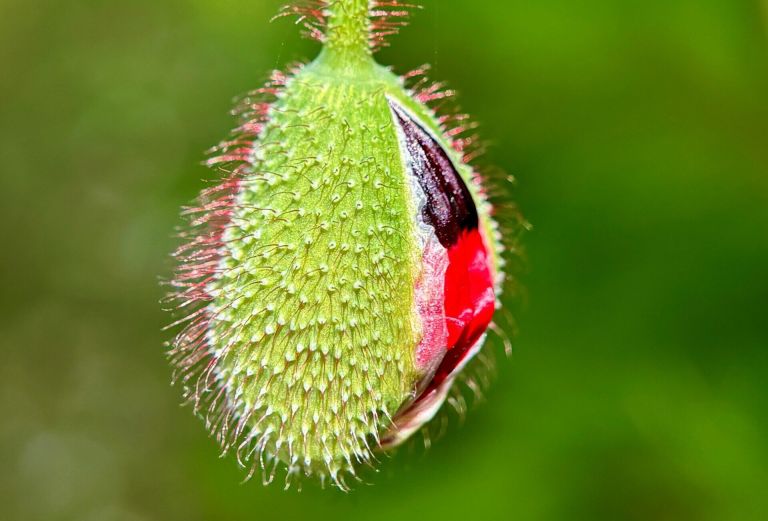
Poppies have a reputation for looking fragile, but their architecture tells a completely different story. The next time you spot a poppy bud covered in reddish coloured hairs, you are witnessing a masterclass in evolutionary engineering, where a delicate flower builds its own winter coat, sunscreen and drought shield all out of its own petal pigments.
